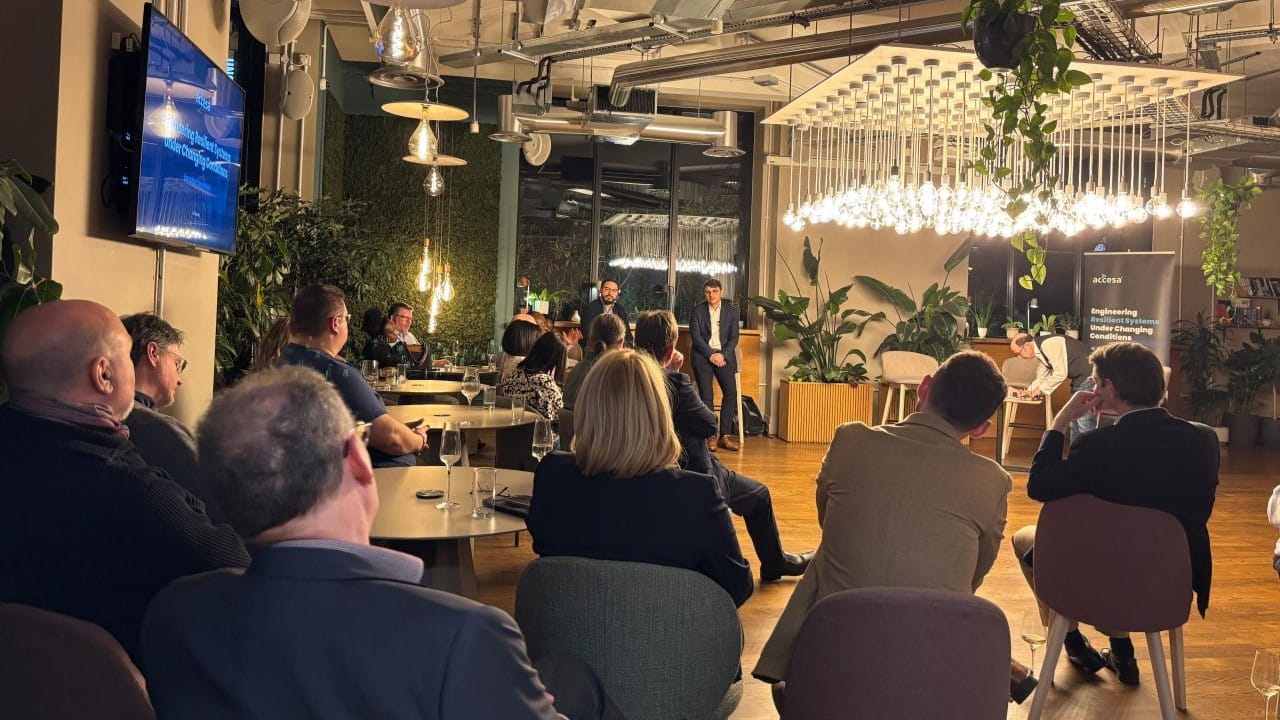
In March 2026, we organised a private roundtable in London, bringing together senior leaders from financial services, retail, digital transformation, and adjacent fields. The session explored what it means to build and sustain resilient systems when the conditions in which those systems operate are themselves in constant flux.
In our experience working across multiple European markets, these challenges tend to surface most clearly in environments where systems have evolved over time and where reliability cannot be compromised.
Supporting these environments typically involves a combination of system modernisation, integration, and long-term operational responsibility rather than isolated transformation efforts.
The conversation ranged widely, across engineering practice, organisational design, regulation, the human dimension of transformation, and the emerging pressures of artificial intelligence and agentic automation. What emerged was not a single, tidy answer, but a rich set of tensions: between speed and stability, innovation and control, adaptability and consistency, short-term performance and long-term durability.
Based on that conversation and the resulting insights, we’ve prepared a report that distils the principal themes and perspectives uncovered during the roundtable. It does not offer a one-size-fits-all solution to the tensions many businesses feel. Instead, it explores those challenges and the potential ways to manage them intelligently, creating organisational resilience.
In this article, we will go over the key themes from the roundtable and what they mean for building resilience, as well as giving you access to the full report.
Resilience Is Not a Destination
One of the most compelling ideas to emerge from the discussion was that resilience is not a milestone to be reached. It is an ongoing capability that is built (and rebuilt) through everyday decisions.
Organisations do not become resilient simply by completing a transformation program or implementing a new technology platform. They become resilient through the way they design systems, respond to disruption, and adapt as conditions change. In this sense, resilience is less an end state and more a by-product of disciplined, continuous evolution.
This perspective shifts the conversation in an important way. Rather than asking whether a business is resilient, leaders may find it more useful to ask whether their systems and operating models are becoming more capable of absorbing change over time.
Design for Failure, Not for Stability
A principle that resonated strongly throughout the roundtable was that resilient systems are designed with the expectation that things will go wrong.
This is a subtle but significant distinction. Systems built on the assumption of stability tend to perform well until those assumptions are challenged. Systems designed for failure, by contrast, are structured to recover quickly, contain disruption, and continue operating even when individual components break down.
Participants repeatedly returned to the value of simplicity. Simpler systems are easier to understand, maintain, and repair. They also make it easier to identify weaknesses before those weaknesses become systemic problems.
The implication is clear: resilience does not come from eliminating risk. It comes from creating architectures and processes that can withstand it.
Resilience Is as Much Organisational as Technical
The conversation made it equally clear that resilience cannot be engineered solely in code or infrastructure.
Technology plays a critical role, but it operates within a broader organisational context. Decision-making structures, governance models, team autonomy, and institutional culture all shape how effectively an organisation responds under pressure.
Several participants noted that rigid businesses often mirror rigid systems: efficient under normal conditions, but brittle when confronted with unexpected change. More resilient organisations tend to be adaptable by design, with enough flexibility and capacity to absorb shocks without losing momentum.
In this sense, resilience is socio-technical. It emerges when engineering practices and organisational behaviours reinforce one another.
Agentic AI Raises the Stakes
Artificial intelligence was one of the most forward-looking themes of the session, particularly the emergence of agentic systems capable of taking increasingly autonomous action.
Participants were broadly optimistic about the opportunities these technologies create, but they also highlighted a central concern: companies may adopt AI faster than their governance and control mechanisms can support.
The challenge is not simply technical. As automation becomes more autonomous, the importance of oversight, accountability, and clear operating boundaries increases. Systems that are designed to improve efficiency can introduce new forms of fragility if the underlying guardrails are not equally robust.
For many leaders, this represents one of the most important resilience questions of the coming years.
Learning Is the Mechanism Behind Resilience
If resilience is built over time, then learning is the process that makes that possible.
The organisations best equipped to handle disruption are not those that avoid failure altogether, but those that extract meaningful insight from experience and use it to strengthen their systems and operating models.
This requires more than post-incident reviews or retrospective discussions. It requires institutional feedback loops that translate lessons into concrete changes.
As one theme repeatedly surfaced throughout the roundtable, resilience depends on a genuine response to change, not merely an acknowledgement that change has occurred.
Explore the Full Report
These insights represent only a small part of a much broader discussion involving senior leaders from financial services, retail, and digital transformation.
The full report, Engineering Resilient Systems in Changing Conditions, explores how organisations are navigating the tensions between speed and stability, innovation and control, and automation and governance.
:format(webp))
:format(webp))
:format(webp))